
Is Their In-Person Class Truly Different—or Is It Their Online Course Delivered in a Room?
Before you choose an in-person contractor exam prep class, ask one important question: what actually changes when you walk into the room?
Not where the course happens. Not whether there are chairs. Not whether somebody turns on a projector. What actually changes in the way you are taught—and in what happens inside your mind as a result.
Takes 2 minutes. Limited seats. First come, first served.
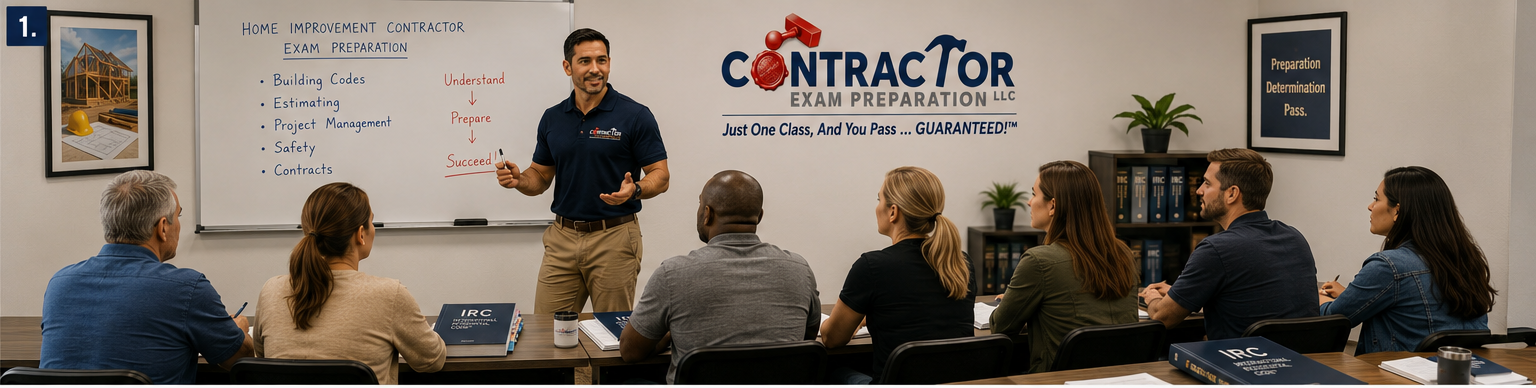
What Is Materially Different About the Teaching?
Many training companies now offer both online courses and in-person classes. And there is nothing wrong with online training—there are excellent online courses in almost every field imaginable.
But if you are specifically choosing in-person instruction, there is an important question worth asking: what is materially different about the teaching?
Not where the course happens.
Not whether there are chairs.
Not whether somebody turns on a projector.
What actually changes in the way you are taught—and in what happens inside your mind as a result? That distinction matters.
Information Is Not the Same Thing as Instruction

A book can deliver information.
A video can deliver information.
A slide presentation can deliver information.
An online course can deliver information.
Instruction begins when somebody notices whether the information actually landed.
An experienced instructor can look around a room and recognize that something isn't connecting. Nobody necessarily has to raise a hand. Everyone may even nod politely. But an experienced instructor can often see the hesitation. The expressions. The uncertainty.
That unmistakable look that says:
That's when the instructor can stop. Reframe the concept. Use a different example. Simplify it. Connect it to something the student already understands. Organize the information differently. Then watch again. Until eventually:
“Oh. I get it.”
That moment is important. Because the objective of good training shouldn't simply be to expose you to information. It should be to organize the material so you understand it, recognize it, remember it, and know what to do with it.
A prerecorded course cannot notice that six people just developed exactly the same confused expression. An experienced instructor can.
PowerPoint has many talents. Reading the room is not currently one of them.
Real Instruction Changes When the Student Needs It To
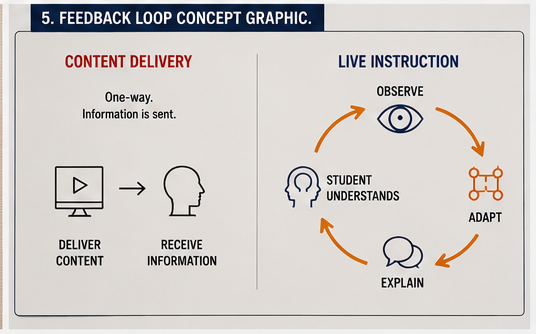
True live instruction creates a feedback loop. The instructor teaches. The students respond—even when they don't say anything. The instructor observes. And, when necessary, the teaching changes.
Sometimes an explanation needs to be simpler. Sometimes the student knows the rule but doesn't understand why it works. Sometimes several disconnected pieces need to be organized into one idea that finally makes sense. Sometimes a different example suddenly makes everything click.
And sometimes a good instructor simply realizes:
That isn't a failure of instruction. That is instruction.
The important question isn't merely: “Was there an instructor physically standing in the classroom?”
A better question is: “Did the teaching change because the students were in the classroom?”
CEP Was Built Differently
CEP does not have an online version of this training. That is not an omission. It is a choice.
Contractor Exam Preparation was built from the ground up around:
Our classroom is not a secondary delivery option. It is the method.
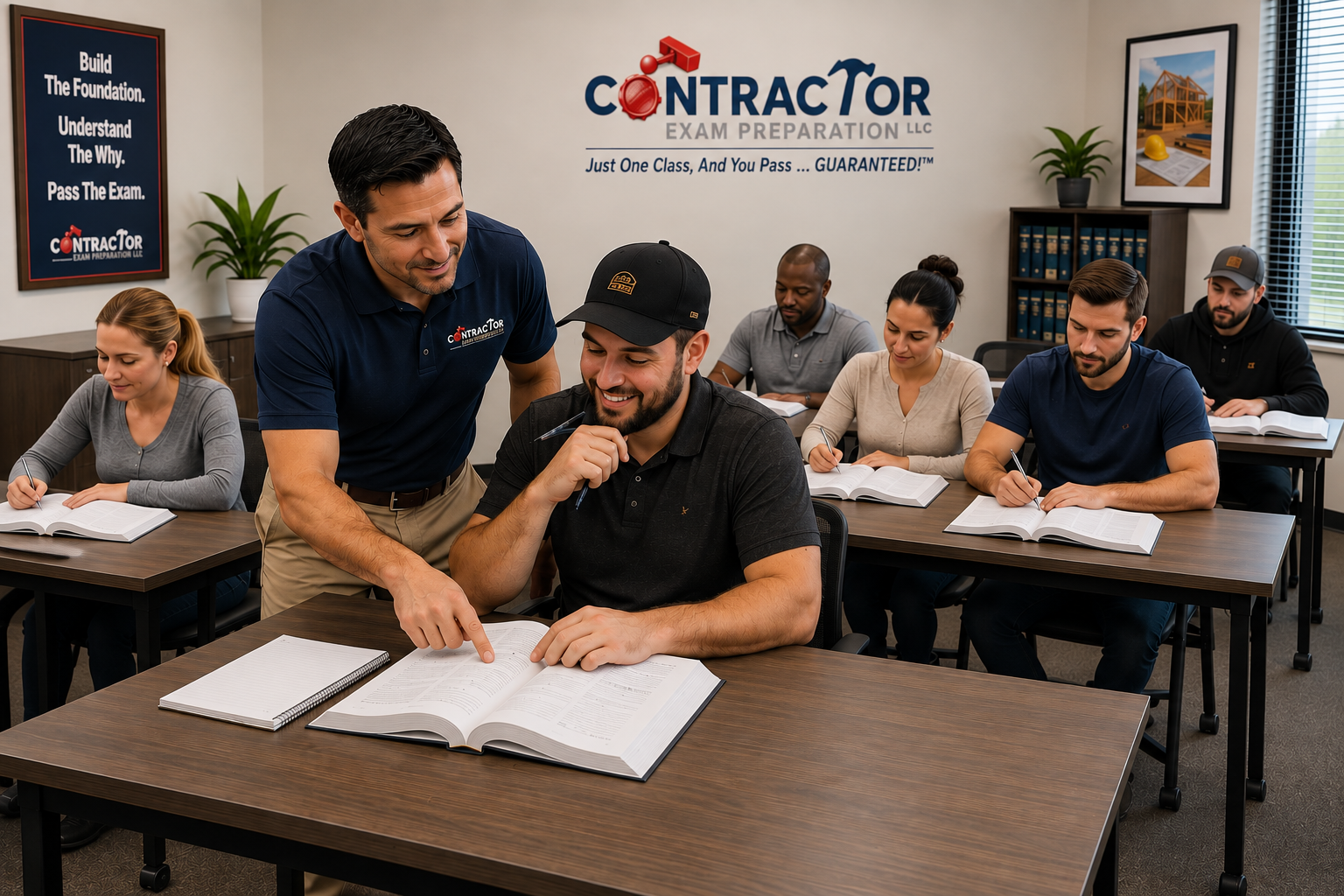
The instructor, interaction, observation, questions, explanations, examples, and ability to change direction when something isn't landing are integral parts of the program. We aren't taking an online product and finding another place to deliver it. The program itself was designed around what can happen when an experienced instructor and students are together in the same room.
There is nothing wrong with a company offering multiple ways to consume its training. But an option and a method are not necessarily the same thing.
So if a company offers essentially the same program both online and in person, it is reasonable to ask: did the training actually change…or did the training simply change addresses?
Ask Them Directly
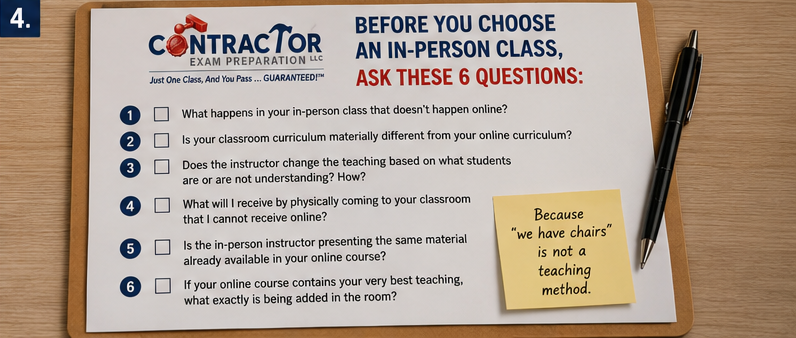
If you're considering an in-person contractor exam-preparation program from a company that also offers online training, we encourage you to ask some questions. Not “gotcha” questions. Good buying questions. Good training providers should be able to answer them.
What specifically happens in your in-person class that does not happen in your online course?
Listen carefully to the answer. You're looking for differences in teaching, not simply differences in location.
Is your classroom curriculum materially different from your online curriculum?
Are the explanations, examples, teaching methods and interaction different? Or is substantially the same program being delivered through another format?
Does the instructor change the teaching based on what students are or are not understanding? And how?
Ask for specifics. How does the instructor recognize that something isn't connecting? What happens then? Does the instructor use another example? Reorganize the concept? Explain the reasoning differently? Simplify it? Or does the class simply continue through the prepared material?
What will I receive by physically coming to your classroom that I cannot receive from your online program?
That's not a trick question. If you're choosing live instruction, there should be a meaningful educational reason for being there.
Is the in-person instructor essentially presenting the same material already available in your online course?
Is the instructor actively teaching the students in front of him or her? Or primarily delivering a prepared program? Those can be very different experiences.
If your online course contains your very best teaching methods, explanations, examples and strategies, what exactly is being added in the room?
This question deserves a thoughtful answer. If the company's best teaching is already completely packaged online, what remains unique to the live classroom? And if meaningful things do happen only in person…what are they?
And Here's One Question Most People Never Think to Ask
If every one of a company's best explanations, teaching methods, processes and insights is permanently available online for anyone to access—including competitors—what, if anything, is being reserved for the live classroom?
We're not suggesting that every training company approaches that question the same way. We're suggesting that it's worth asking.
Some things work extremely well online. Some teaching benefits from happening between an experienced instructor and the people sitting directly in front of that instructor. Some things may simply be better taught in the room…rather than uploaded to the internet with a convenient “Save As” button.
You're Not Really Buying Information
Contractor licensing information isn't particularly difficult to find.
Books exist.
Videos exist.
Online courses exist.
Practice questions exist.
Search engines exist.
And apparently the internet has no plans to close for renovations anytime soon.
The real job of effective instruction is to take unfamiliar material…organize it…strip away unnecessary complexity…connect one concept to another…help you understand the underlying logic…and keep working with it until the material makes sense.
That's why there is such an important difference between delivering content and teaching a person.
Before You Choose an “In-Person” Class, Make the Comparison
Ask the questions on this page.
Seriously. Write them down. Call the training company. Ask.
Then listen carefully to the answers. Because the words “in-person class” can describe very different things.
One company may be providing essentially the same material it delivers online, only now in a classroom. Another program may have been designed from the beginning around an experienced instructor observing, adapting, explaining, reorganizing and teaching until students understand.
Those aren't necessarily the same product.
At Contractor Exam Preparation:
The classroom is not an add-on.
The instructor is not simply another delivery system.
And finishing the presentation is not the objective.
The objective is for you to understand.
If that's the kind of contractor exam preparation you're looking for, don't simply choose a room. Choose a method. Choose your live Contractor Exam Preparation class and reserve your seat.
Takes 2 minutes. Limited seats. First come, first served.